libvkdaq
VKINGING DAQ Library API Reference
 
Loading...
Searching...
No Matches
View configuration task parameters
Note
Steps of Method 1:
  1. Read the task name, read the task property "Name", and use the function:
    VkDaqGetTaskAttribute
    2.Read the task channel, read the task attribute 'Channels', and use the function: VkDaqGetTaskAttribute
    3.Read the sampling rate, read the task property 'SamplingFrequency', and use the function: VkDaqGetTaskAttribute


    Supports two ways to obtain detailed configuration information, but both require parsing in JSON forma


    Steps of Method 1:
    1.Open the assistant and enter the interface for creating regular tasks.
    2.Export regular tasks
    3.Open in text format
    4.Parse JSON format to obtain configuration information


    Steps of Method 2:
    1.Read task attribute: 'Detail', use function: VkDaqGetTaskAttribute
    2.Parse JSON format to obtain configuration information

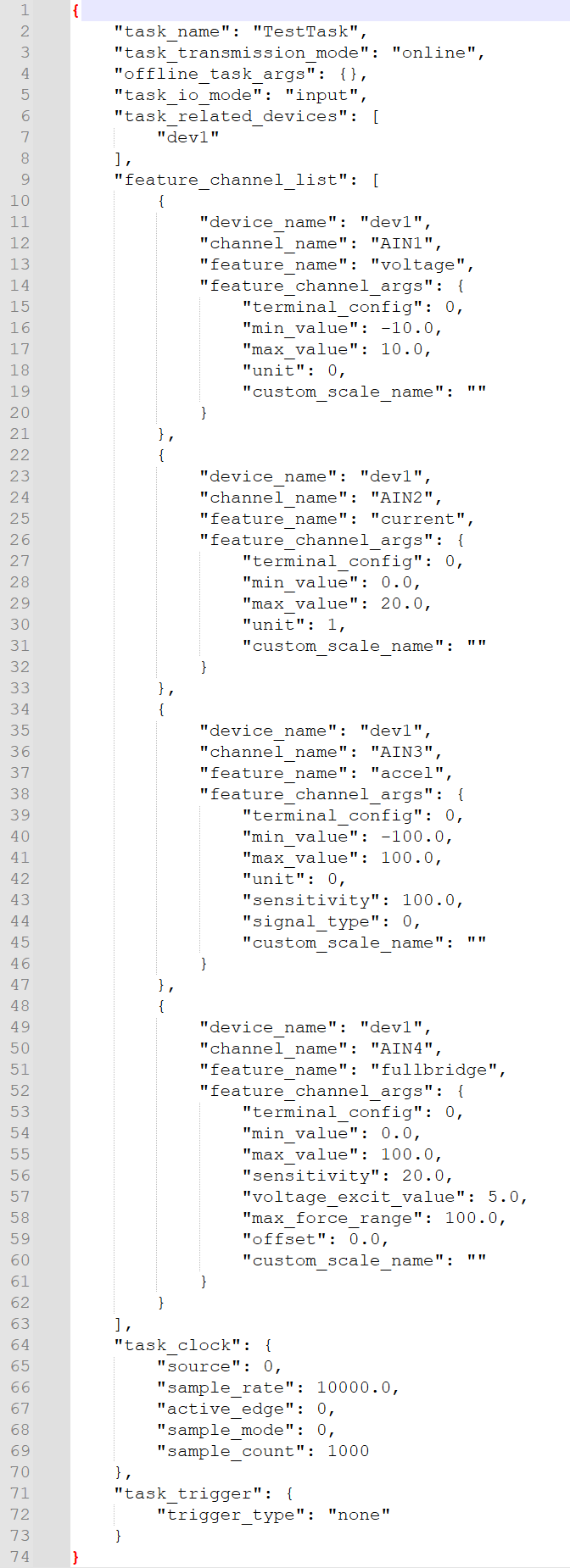
Assistant exports regular task configuration JSON data Process Diagram

Key Name Data Type Parameter Description
task_name String Task name
Example: TestTask
task_transmission_mode String Transmission mode:
online: Online acquisition mode
offline_task_args String Not supported yet
task_io_mode String DAQ card mode:
input: Input mode, performs ADC acquisition
output: Output mode, performs DAC output
task_related_devices String Hardware devices related to the task
Example: dev1
Note: A task can support multiple devices
feature_channel_list String Array Device channels and their configurations related to the task
Note: A task can support different channels from multiple devices
device_name String In channel configuration, the hardware device name corresponding to the channel
channel_name String In channel configuration, the channel name
feature_name String In channel configuration, the physical measurement type of the channel
voltage: Voltage
current: Current
accel: Acceleration
fullbridge: Full Bridge
feature_channel_args String Array In channel configuration, the specific parameters for the channel
Note: Different physical measurement types have different parameters
terminal_config int In channel configuration, the input terminal configuration for the channel
0: Single-ended
1: Differential
min_value int In channel configuration, the expected minimum measurement value for the channel
max_value int In channel configuration, the expected maximum measurement value for the channel
unit int In channel configuration, the unit for the channel
In voltage mode:
0: V

In current mode:
0: A
1: mA

In accel mode:
0: mV/g, mV/N.
1: m/s^2.
2: in/s^2.
4: V.
sensitivity int In channel configuration, the sensitivity of the channel
task_clock String Array Task sampling clock configuration
source int Clock source
0: Internal clock.
1: External sync pulse.
2: Master-slave mode.
sample_rate int Sampling rate
sample_mode int Sampling mode
0: Continuous acquisition
1: N samples acquisition
sample_count int Number of points (N) for N samples acquisition mode
task_trigger String Array Task trigger configuration
trigger_type String Trigger type
"none": No trigger
"analog_edge": Analog trigger
"digital_edge": Digital trigger
trigger_edge int Trigger edge
0: Falling edge
1: Rising edge
2: Low level
3: High level
(Note: Original had '1' listed twice, assuming 3 for High Level)
trigger_level double Trigger level
Valid only under analog trigger condition
pretrigger_sample_size int Pre-trigger sample count
The number of points to acquire before the trigger event

C language reference

#include <stdio.h>
#include "libvkdaq.h"
#define TASKNAMEMAX 4096
#define VkDaqErrChk(functionCall) if( VkDaqFailed(error=(functionCall)) ) goto Error; else
int main(void)
{
char taskNames[TASKNAMEMAX];
char firstTask[TASKNAMEMAX];
int32 error = 0;
// Read the current configured task name
VkDaqErrChk(VkDaqGetTasks(taskNames,TASKNAMEMAX));
printf("taskNames: [%s]\n",taskNames);
// Select the first task read
comma = strchr(taskNames, ',');
size_t len;
if (comma == NULL) {
len = strlen(taskNames);
}
else {
len = (size_t)(comma - taskNames);
}
if (len >= sizeof(firstTask)) {
len = sizeof(firstTask) - 1;
}
memcpy(firstTask, taskNames, len);
firstTask[len] = '\0';
printf("firstTask= %s\n", firstTask);
// Optional: Read the properties of the current task.
// 1. String types: trigger type, sampling rate, number of channels, input type.
// 2. Detailed configuration of JSON format tasks
VkDaqErrChk(VkDaqGetTaskAttribute(firstTask, "Attributes", TaskConfigValue, TASKNAMEMAX));
printf("Attributes= %s\n", TaskConfigValue);
VkDaqErrChk(VkDaqGetTaskAttribute(firstTask, "Name", TaskConfigValue, TASKNAMEMAX));
printf("Name= %s\n", TaskConfigValue);
VkDaqErrChk(VkDaqGetTaskAttribute(firstTask, "Channels", TaskConfigValue, TASKNAMEMAX));
printf("Channels= %s\n", TaskConfigValue);
VkDaqErrChk(VkDaqGetTaskAttribute(firstTask, "ChannelsAvailable", TaskConfigValue, TASKNAMEMAX));
printf("ChannelsAvailable= %s\n", TaskConfigValue);
VkDaqErrChk(VkDaqGetTaskAttribute(firstTask, "Mode", TaskConfigValue, TASKNAMEMAX));
printf("Mode= %s\n", TaskConfigValue);
VkDaqErrChk(VkDaqGetTaskAttribute(firstTask, "SamplingFrequency", TaskConfigValue, TASKNAMEMAX));
printf("SamplingFrequency= %s\n", TaskConfigValue);
VkDaqErrChk(VkDaqGetTaskAttribute(firstTask, "Detail", TaskConfigValue, TASKNAMEMAX));
printf("Detail= %s\n", TaskConfigValue);
Error:
if (VkDaqFailed(error))
printf("VkDaq Error: %s\n", VkDaqGetLastErrorInfo());
printf("End of program, press Enter key to quit\n");
getchar();
return 0;
}
int32_t VkDaqGetTaskAttribute(const char *task, const char *attrName, char attrValue[], int32_t size)
Get task attribute value.
int32_t VkDaqGetTasks(char tasks[], int32_t size)
Get task.
const char * VkDaqGetLastErrorInfo(void)
Get the error message of the last execution.